Project Aims and objectives:
This project sought to improve the health of Nias communities through delivery of safe, clean water and sanitation through wells, springs, rainwater tanks and building public latrines and hygiene education
Specifically to;
- Provide clean water to communities affected by preventable diseases caused by a lack of access to clean water supplies.
- Reduce child mortality through the improvement of access to water and healthier sanitation practices.
- Provide a model for encouraging communities to take responsibility for their own hygiene practice.
- Foster community participation and ownership of the project to ensure the long-term maintenance of the facilities.
Processes
The specifics of the link between hygiene and health are often poorly understood in isolated Nias communities. Consequently SurfAid adopted the Community-led Total Sanitation (CLTS) approach, which provides a graphic introduction to the relationship between open defecation and community health. Within CLTS the process of "triggering" focuses on raising community awareness of the health risks associated with open defecation, and by the end of the triggering process it is expected that some individual community members will be sufficiently motivated to undertake to build their own latrines.
Like all other Watsan interventions, CLTS is only effective where there is on-going community support. Therefore SurfAid has focused considerable resources into ensuring that communities receive hands-on assistance in the form of training, education, and technical and logistical support.
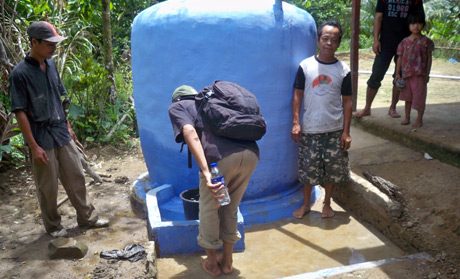
Ferrocement tank for rain water harvesting in dusun Botolala-Afulu
Project Activities
CLTS has been implemented in 13 dusun (hamlets) in five villages in Afulu and Alasa. This process of triggering is designed to raise awareness of the sanitation status of the community, and to motivate community members to take action for themselves. At the end of each triggering session, members of the community are invited to sign up (literally, on a large piece of paper located in a prominent position) to construct their own latrines using local materials. In some instances community members who did not sign up to manufacture latrines at the time of CLTS triggering will be motivated by the efforts of their neighbours and will build their own (eg Botolala signed up for 68 latrines and ultimately built 79).
There is no subsidy offered by SurfAid for the construction of latrines. However SurfAid does provide support, which is delivered by two Community Facilitators and three Technical Facilitators who have been recruited to help deliver this program.
The significance of the CLTS component of this program is demonstrated by the fact that 257 latrines have been constructed, and a further 80 have been committed. In addition, these triggered communities now have an appropriate internal process by which the construction, maintenance and use of latrines can be monitored, the community action plan implemented and the objective of ODF (open-defecation free) achieved.
In order to attempt to improve the incremental value-add still further, SurfAid has continued to try to identify natural leaders within some individual communities, and to encourage and support them to lead their own CLTS process (without the hands-on support of SurfAid staff members). This process was piloted with two women from Sitiboa, who implemented CLTS triggering in their own community, then successfully established a commitment to build 24 latrines (which eventually became 26). This self-realisation is a key component of the CLTS process.
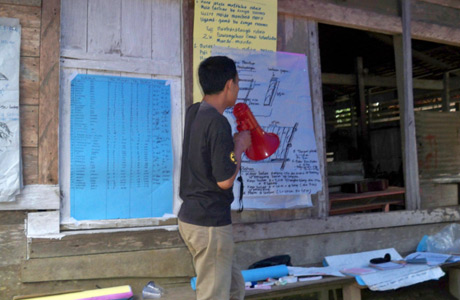
Choosing a technology design for a simple latrine in Dusun Botolala-Afulu. This is one of the steps of the Community Led Total Sanitation process.
Facilities Construction
Provision of Watsan facilities to some individual communities has also been an integral component of this program to date.
- Water Committees have been established in each of the 13 dusuns.
- Communities have participated in the design of the facilities proposed for construction, and have been charged with collecting information and data to inform the planning and ensure the designs are appropriate for local conditions.
- Memos of Understanding (MoUs) have been developed and signed with senior representatives from each of the 13 dusuns, which formalises the agreement between the community, its individual members and SurfAid. These MoUs also highlight the responsibilities of each party.
- A schedule for construction has been agreed with each community.
Tracking Progress
Community baseline data has been collected as part of the CLTS process. The key indicators for achieving CLTS are:
- A measurable decrease in the number of cases of diarrhoea in the previous two weeks.
- Open defecation free, with every household having access to a latrine.
- Committed latrines have been constructed.
- Hand washing with soap.
- Access to clean water.
- Safe disposal of waste waters.
- Separation of solid wastes.
- Clean preparation of food.
- Clean storage of drinking water and foods.
In this program, the focus of CLTS has been the construction of latrines and the drive towards community-wide ODF status. Throughout the program SurfAid staff have monitored progress in each community. This has been done both formally and informally, and has required visits to individual households in order to assess hygiene behaviour, monitor the use of latrines, and make an assessment on the ODF status of the community.
Depending on the outcome of these assessments, individual households are classified as green, yellow or red. This simple approach is particularly appropriate for isolated communities which contain a high proportion of illiteracy. The status is determined by the following guidelines:
- Green. The household is completely open-defecation free, and has a latrine.
- Yellow. The household is ODF, but does not have its own individual latrine.
- Red. The household still practices open-defecation.
Total households assessed: 312
Total green status: 236 (76%)
Total yellow status: 36 (12%)
Total red status: 42 (13%)
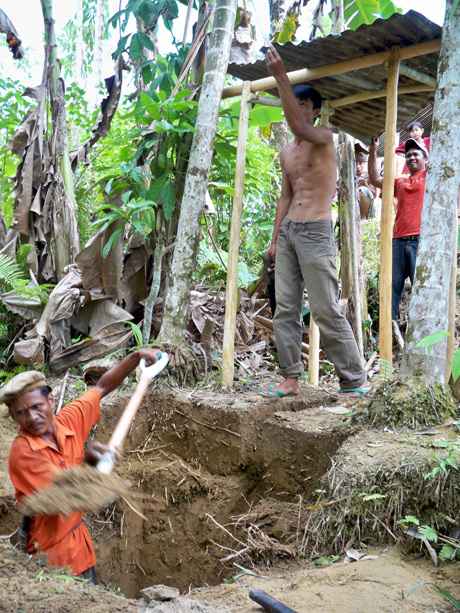
Community start to build a simple latrine with support from SurfAid International staff
Project Expenditure
Footprints fundraising was directed to a component of the larger WATSAN Nias project with multiple funding partners, the following financial report is therefore a percentage of the total funds directed to the two sub districts of Afulu and Alasa.
Total Footprints Component $10,017
including components for
Plant and Equipment: $3815
Transportation: $3820
Community Training: $2382
The future of this project:
The key objective for the next two months is to complete the construction phase of the project. While this has been delayed, there are no major hurdles left to be tackled and the SurfAid team will be able to work through the backlog and complete the job by the end of June 2010.
SurfAid will also follow up each of the communities that have been triggered and continue to provide logistical and technical support with latrine construction. It is anticipated that the success rate in converting committed latrines to actual latrines will be close to 100% by the end of June, and well over that figure by the end of 2010. This represents outstanding value-add to the money already spent on the project.
Through the Community Based Health Program in Nias, SurfAid will use the learning experiences from this project to improve CLTS triggering and follow-up, and will incorporate this experience into the CLTS work in the Mentawai Islands. Community groups will be encouraged to request support whenever it is required.
There is further follow-up required with regard to the ODF status of individual households and wider communities and review and assessment of facilities requiring repair and maintenance. Over the course of the next six to 12 months, communities will continue to be monitored and their status tracked.
Staying in touch
You can stay in touch with this project and other work work via SurfAid's Twitter Feed and Facebook page.
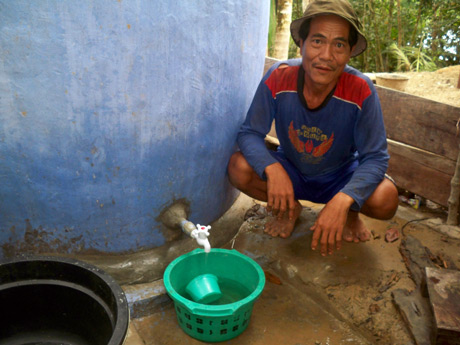
Community access water from ferro cement rainwater tank in Hiligawono, Afulu area
Project Costs include
- plant and equipment expenses for
* Digging wells, rehabilitating springs, creating gravity flow water systems, supplying rainwater tanks (solutions are tailored for each specific village)
* Demonstration family sized toilets; these are a replicable design that will be built mainly with locally available materials. (The type of latrine will depend on the customs of the village regarding bathroom use, cleansing habits and availability of water)
- transportation costs
- community training and socialisation costs for hygiene education and equipment maintenance
- staff and management of the program.
This Footprints funded project to provide clean water and sanitation for 315 people at a cost of A$31.80 each is part of SurfAid’s much larger program in Nias (full details below)
Project Objectives
- To provide clean water to communities affected by preventable diseases caused by a lack of access to clean water supplies
- To reduce child mortality through the improvement of access to water and healthier sanitation practices
- To provide a model for encouraging communities to take responsibility for their own hygiene practices
- To foster community participation and ownership of the project to ensure the long-term maintenance of the facilities.
Project need
Results from a recent SurfAid International survey demonstrate the genuine need for such an initiative as the Community Led Water Security and Total Sanitation Project. In the two areas targeted in this proposal, Afulu and Alasa, diarrhoea rates were 35% and 45% respectively. The Indonesian national average, using the same measurement criteria, is 11%.
Part of a larger project
This project builds on the successful water and sanitation (watsan) project which has already been implemented in Nias, by SurfAid International, that will bring clean water and sanitation to over 2300 households and improve the lives of more than 11,000 individuals.
This Community Based Health Project has stressed the link between hygiene and health (particularly diarrhoea in young children) and has provided training, support and mentoring to partner communities in Nias in an attempt to change current hygiene practices.
Ingestion of unsafe water, inadequate availability of water for hygiene and lack of access to sanitation contribute to about 1·5 million child deaths, and around 88% of deaths from diarrhoea each year worldwide . Improvements in water supply and sanitation in the last 20 years have helped to cut the incidence of diarrhoea. But if these technologies have had an impact on health, it is because they make better hygiene possible .
Information about Nias Archipeligo
The archipelago of Nias is situated off the western coast of North Sumatra. It ranks amongst the poorest areas in Indonesia according to economic indicators and literacy rates. Water provision is a long standing difficulty faced by many villages on the island. Even though rainfall is very high, with over three meters of rain a year and 270 rainy days, there are still many villages and families that suffer from insufficient water supply, water contamination, because of a lack of sound construction knowledge and water sources that are more than one kilometre away.
In these villages, women and children are principally responsible for carrying water for household needs, and in most villages spend more than three hours daily engaged in this task.
In addition to these pre-existing difficulties, an earthquake registering 8.9 on the Richter scale struck Nias on March 28, 2005. Approximately 700 people were killed and many personal and community water supplies were badly damaged or destroyed. The earthquake also had the effect that few people envisioned possible, it raised the reef on the west and south coasts of Nias from one to four meters.
This earthquake had a devastating effect on the water supplies of the villages in those areas. In addition to the collapse of wells (many of which were originally badly designed or built with faulty material), the ground level of many wells rose above the water table. Spring sources that had cement catchments have been badly damaged and some springs have had the water flow greatly reduced. The piping for community gravity and pumped water systems has been damaged. Village water supply reconstruction in many communities is ongoing or complete, however many villages have still received no assistance to improve access to water reduced vulnerability due to poor hygiene practices.
References
1 Robert E Black, Saul S Morris, Jennifer Bryce (2003) Where and why are 10 million children dying every year? The Lancet 2003; 361: 2226–34
2 UNICEF (1999) Towards Better programming - A manual on hygiene promotion, Water, Environment and Sanitation Technical Guidelines Series No. 6
3 KAP (SurfAid’s Knowledge, Attitude and Practice survey, 2007)